
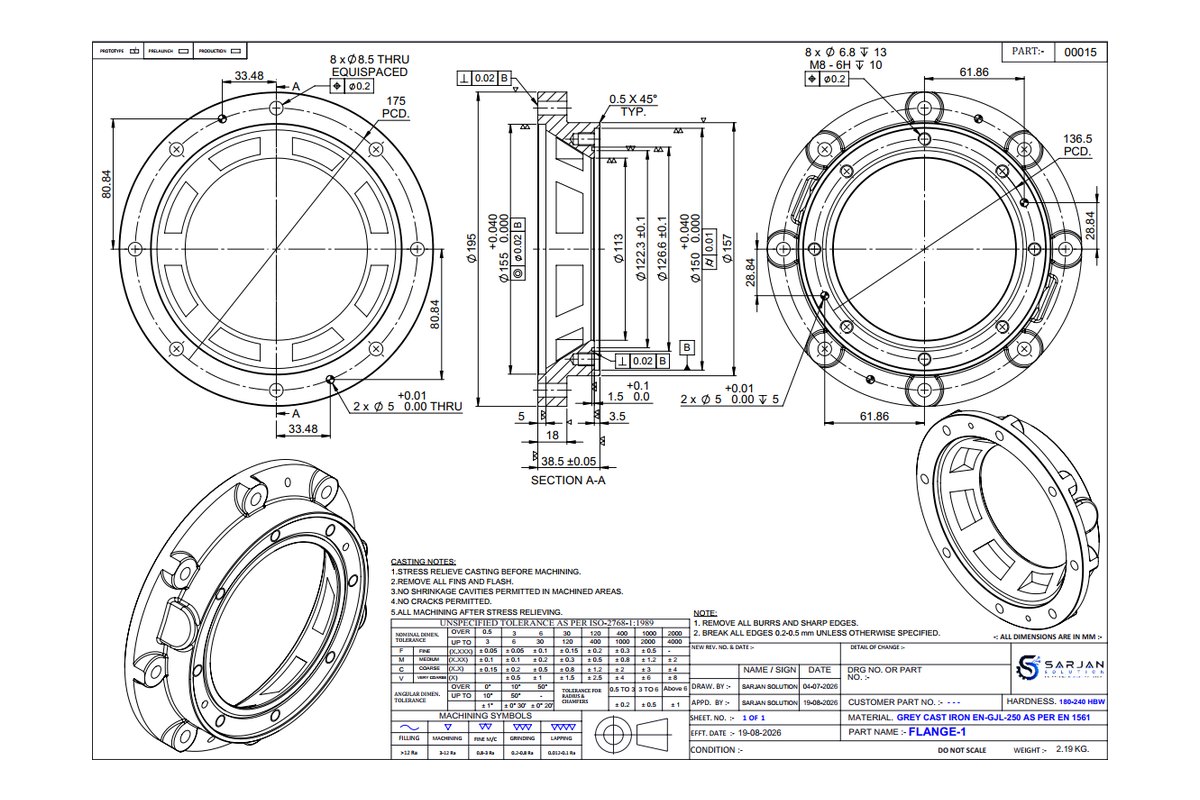
Standards
ASME Y14.5 vs ISO GPS: Drawing Standards Your Outsourcing Partner Must Get Right
Two drawings can use identical symbols and still specify different parts. Here are the differences that matter when work crosses the Atlantic — or crosses to a supplier.
Standards3 October 2026·By The Sarjan Solution Team
North American companies detail their drawings to ASME Y14.5. Most of the rest of the world — the UK (through BS 8888), Europe, Australia and much of Asia — uses the ISO Geometrical Product Specifications (GPS) system. The symbols are mostly shared, which is exactly why mistakes happen: a drawing can look correct to both sides and still be read differently by an inspector.
If your parts are made or inspected in another country, or detailed by an outsourcing partner, these are the differences to pin down.
1. The default principle: envelope vs independency
This is the most important difference, and the least visible.
- ASME Y14.5 — Rule #1 (envelope principle). Unless stated otherwise, the limits of size of a feature also control its form. A shaft at maximum material size must be perfectly straight; a bent shaft that measures in tolerance at every cross-section can still be rejected.
- ISO 8015 — independency principle. By default, size and form are independent. Size is checked as local two-point measurements; form needs its own tolerance. To get envelope behaviour you must add the Ⓔ modifier to the size, or reference it in the title block.
The same drawing, with the same numbers, can therefore accept a part under ISO that ASME would reject. When a drawing moves between systems, every fit-critical feature needs reviewing.
2. Projection method
North America uses third-angle projection; Europe, the UK, India and many other countries use first-angle. Both standards define the projection symbol, but it is easy to overlook it in a title block. A part drawn in one and read in the other appears mirrored, so the symbol must always be present and checked.
3. General tolerances
- ASME practice places general tolerances in the title block, typically by number of decimal places (for example ±.01 for two places in inches).
- ISO practice references a general-tolerance standard, most often ISO 2768 (for example "ISO 2768-mK": medium linear/angular tolerances and class K geometrical tolerances). The newer ISO 22081 provides a framework for general geometrical specifications and is increasingly specified in its place.
A drawing converted from one system to the other needs its general tolerance block rewritten. Copying the numbers across is not enough.
4. Units and number formats
ASME drawings in inches omit the leading zero (.250); metric ASME drawings and ISO drawings include it (0.25). Many European drawings use a decimal comma. Mixed-unit assemblies — common when a European machine uses US-sourced components — need a clear statement of which unit applies where.
5. Datums and feature control frames
Both systems use datum features, datum reference frames and feature control frames that look almost identical. Under the surface, the rules for establishing datums differ: ASME Y14.5 and ISO 5459 treat datum simulation, common datums and some modifiers differently. ISO has also added specification modifiers and filter indicators that have no ASME equivalent. For most machined parts the practical result is similar, but for complex or functional datum schemes the standard must be stated explicitly.
6. Surface texture
ASME uses Y14.36 for surface texture symbols, usually in microinches on inch drawings. ISO uses ISO 21920 (the successor to ISO 1302), in micrometres. An "Ra 32" means 32 µin (about 0.8 µm) on an inch drawing, and something entirely different if misread as micrometres.
7. Threads, materials and welds
- Threads: Unified (UNC/UNF) in North America vs ISO metric (M) elsewhere — and thread class versus tolerance class notation differ.
- Materials: ASTM/AISI/SAE grades vs EN designations. Equivalents are close but not identical; specify the grade the supplier will actually buy.
- Weld symbols: AWS A2.4 vs ISO 2553. The ISO system uses a dashed identification line to show arrow-side and other-side welds, which AWS does not.
How to keep it straight with an outsourcing partner
- State the governing standard and edition in every brief and on every drawing (for example "Dimensioning and tolerancing per ASME Y14.5-2018" or "ISO 8015 applies").
- State units, projection and the general tolerance standard.
- Send a finished example drawing that your quality team has approved.
- When converting drawings between systems, ask for a list of every feature where the interpretation changes, not just a redrawn sheet.
We detail to ASME Y14.5 for US and Canadian clients, to BS 8888 for the UK, to AS 1100 for Australia, and to ISO GPS for Germany, the Netherlands and the rest of Europe — or to your own drawing standard. See our drafting and modelling service.
Frequently asked questions
What is the main difference between ASME Y14.5 and ISO GPS?
The default principle. ASME applies Rule #1, so size limits also control form (envelope principle). ISO 8015 applies the independency principle, so size and form are separate unless the Ⓔ envelope requirement is specified.
Does the UK use ASME or ISO?
The UK uses BS 8888, which is built on the ISO GPS standards. Many UK firms supplying the US also produce ASME drawings for those customers.
Is third-angle or first-angle projection used in Europe?
First-angle projection is standard in most of Europe, the UK and India; third-angle is standard in North America. The projection symbol must always appear on the drawing.
Can a drawing be converted from ASME to ISO?
Yes, but not by relabelling. Each fit-critical feature must be reviewed because the default principle changes, and the general tolerance block, surface finish units, threads and weld symbols need converting.
SS
Written by the Sarjan Solution Team
CAD design & engineering consultancy, Ahmedabad & Gandhinagar — delivering CAD, simulation and product design services to manufacturers in India, the UK, Europe and the USA since 2018.
Keep Reading
More Insights
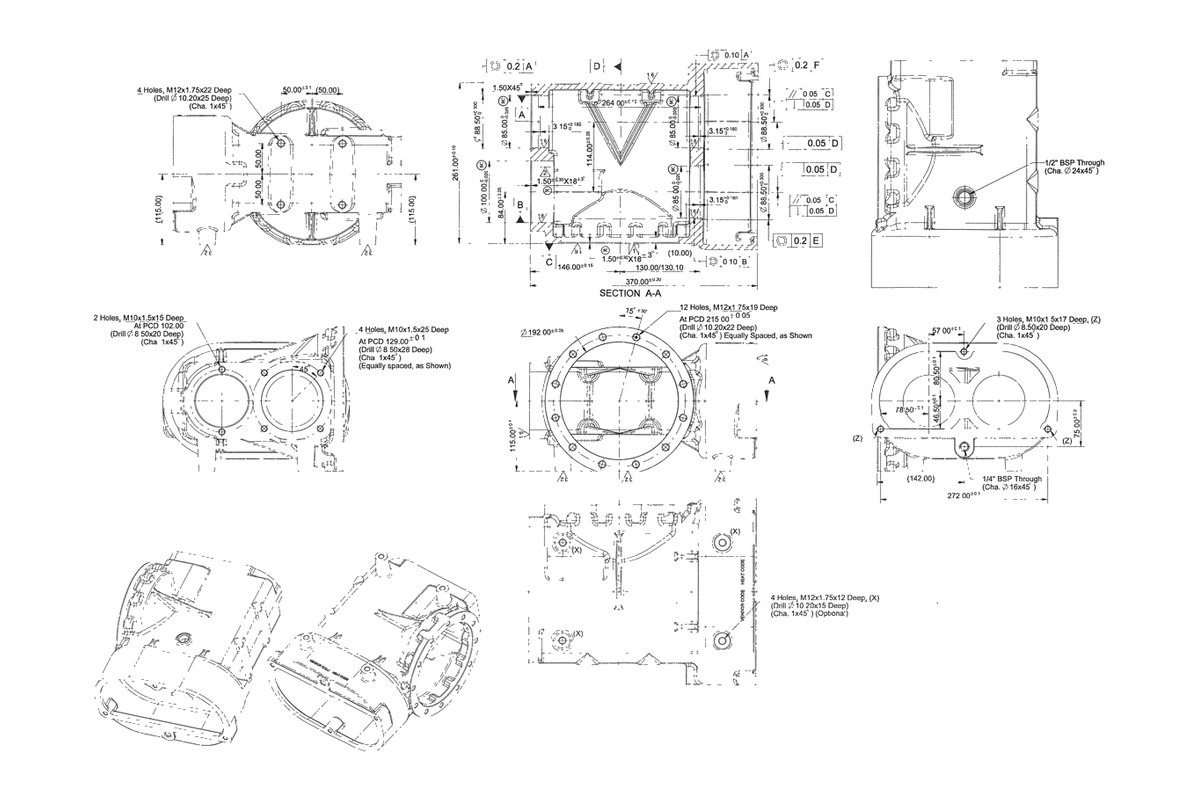
Drawings To ASME Or ISO — Your Call
Send us your requirement with a brief description and we'll reach out with a fixed quote in GBP, USD, EUR or INR — usually within one business day.